
Architecture
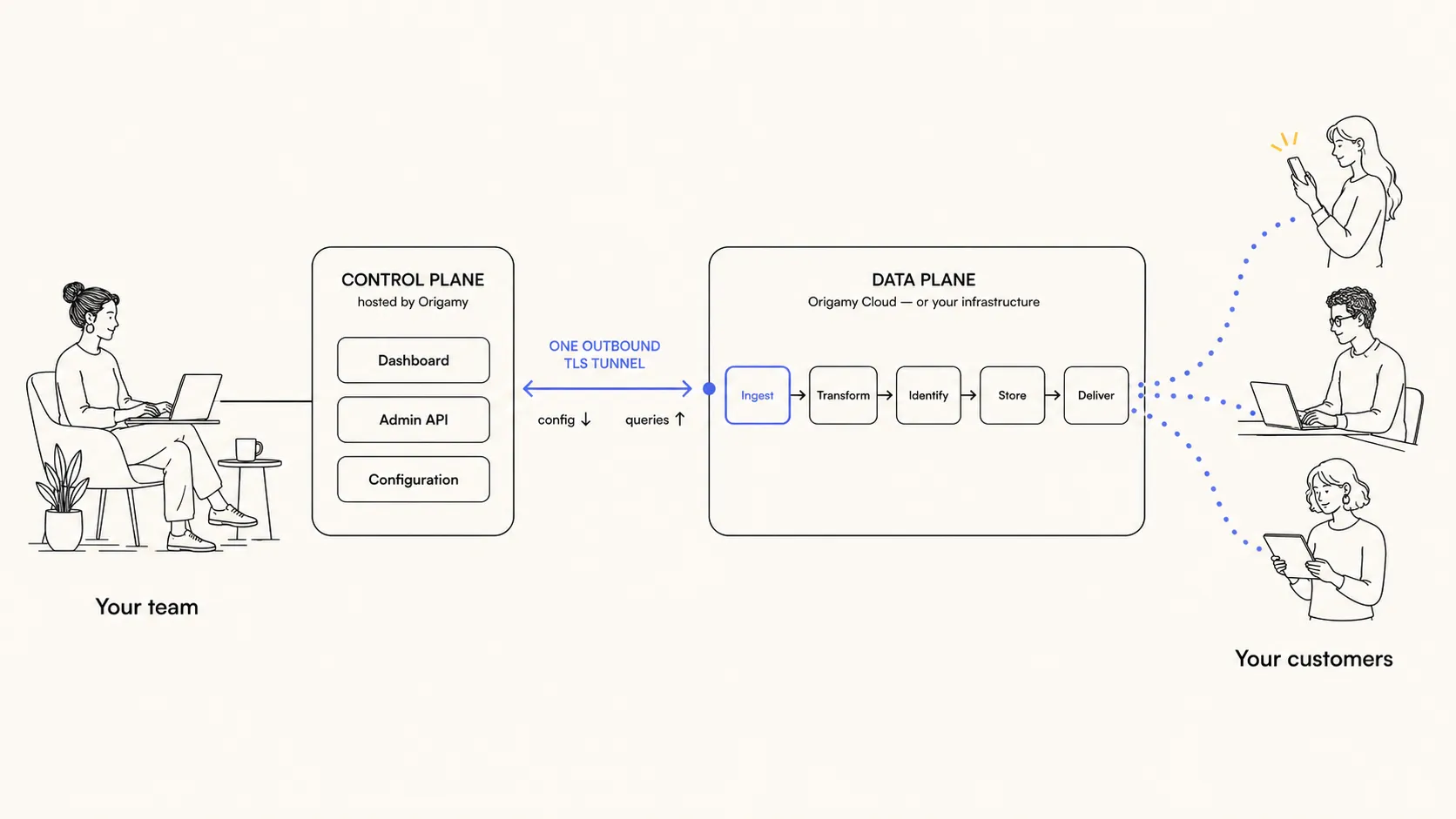
Origamy is built as two planes with one pipeline between them. The control plane is where you configure things; the data plane is where your events live and move. They are separate systems by design: the data plane can run in Origamy Cloud or entirely inside your own network, and the architecture is identical either way.
The two planes
Section titled “The two planes”The control plane is hosted by Origamy and serves the dashboard and admin API at app.origamy.io. It is the source of truth for configuration — sources, destinations, transformations, segments, journeys, message templates, workspace membership. It holds configuration and workspace metadata only; your customer event data is never stored in the control plane.
The data plane is the event pipeline: it ingests, transforms, resolves identity, stores, and routes customer data, and executes messaging workflows. It runs either in Origamy Cloud or in your own infrastructure — same services, same behavior.
The two connect in one direction only. The data plane opens outbound TLS connections to a single Origamy endpoint on TCP 443 and keeps them alive:
- Configuration flows down. A sync service in the data plane pulls its configuration from the control plane and distributes it to the pipeline services. Change a transformation in the dashboard and the pipeline picks it up without a redeploy.
- Queries flow back up the same connection. When the dashboard shows live events, a profile, or an analytics chart, the control plane forwards that query through the established tunnel to the data plane, which answers from its local stores. Queries travel to the data; the data does not travel to Origamy. A self-hosted data plane needs no inbound ports at all.
The event pipeline
Section titled “The event pipeline”Every event takes the same path, whether it came from the Web SDK, a server SDK, or the HTTP API.
- Ingest. Events arrive over HTTPS at the ingestion gateway (
events.origamy.ioin Origamy Cloud; your own hostname when self-hosted). The gateway authenticates the write key, validates the payload, and persists the event to a durable stream before acknowledging — an accepted event is an event that cannot be lost to a crash. - Transform. The transformer engine runs your JavaScript transformations in a sandboxed runtime — filter, redact, enrich, or reshape events in flight.
- Resolve identity. The identity resolver stitches anonymous devices and known users into a single profile, so a visitor who signs up on their phone and buys on their laptop is one customer, not three.
- Fan out. The resolved event goes, in parallel, to the analytics store (ClickHouse), to your connected downstream destinations, and to real-time segment evaluation.
- Act. Segment entries and events trigger the workflow engine, which runs your journeys and delivers messages through the providers you have connected.
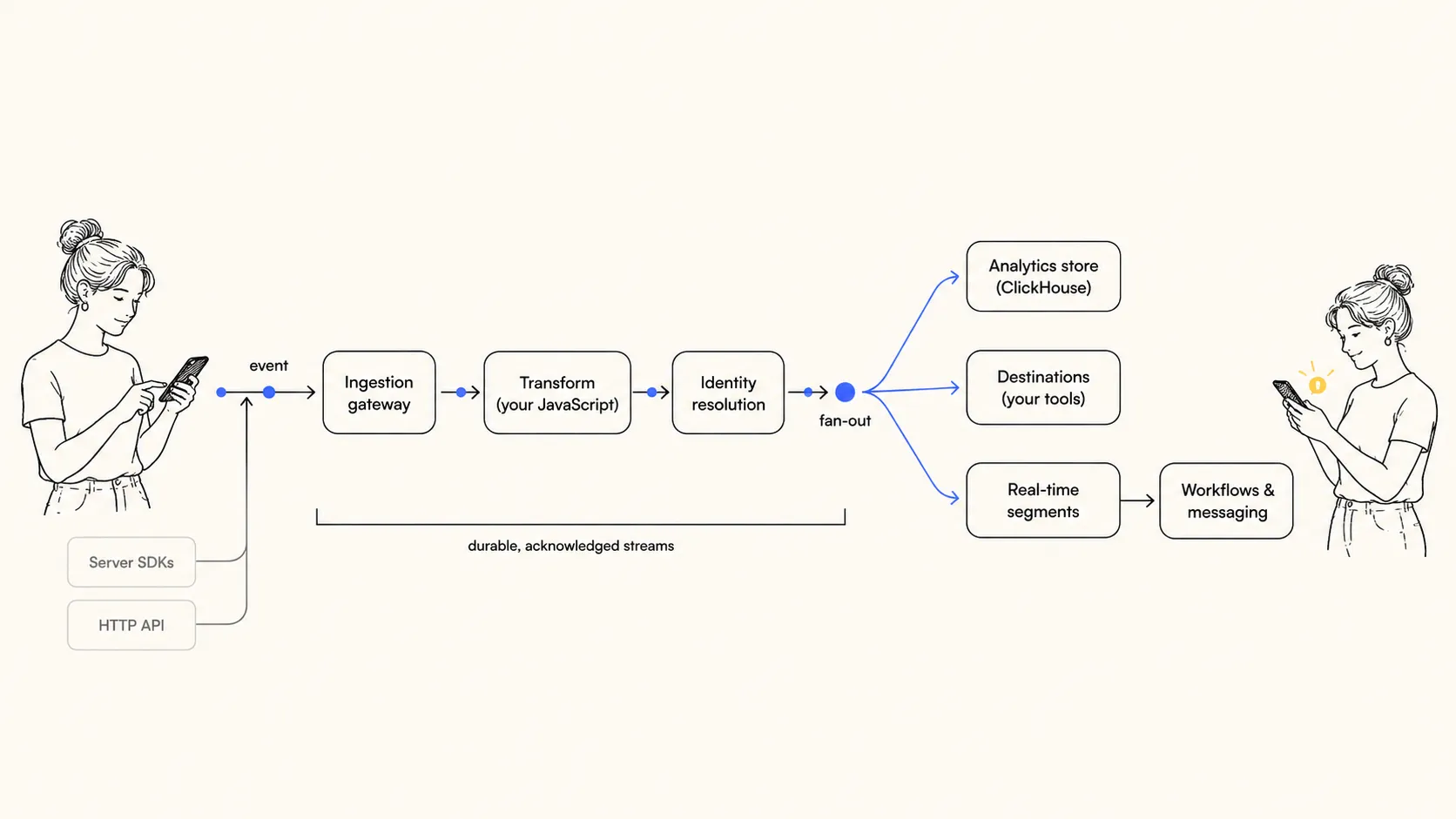
Between every stage sits a durable, acknowledged stream (NATS JetStream). A service crashing mid-event means the event is redelivered, not lost. Events that repeatedly fail processing are parked in a dead-letter queue where you can inspect them — they are never silently dropped, and never replayed behind your back.
Deployment topologies
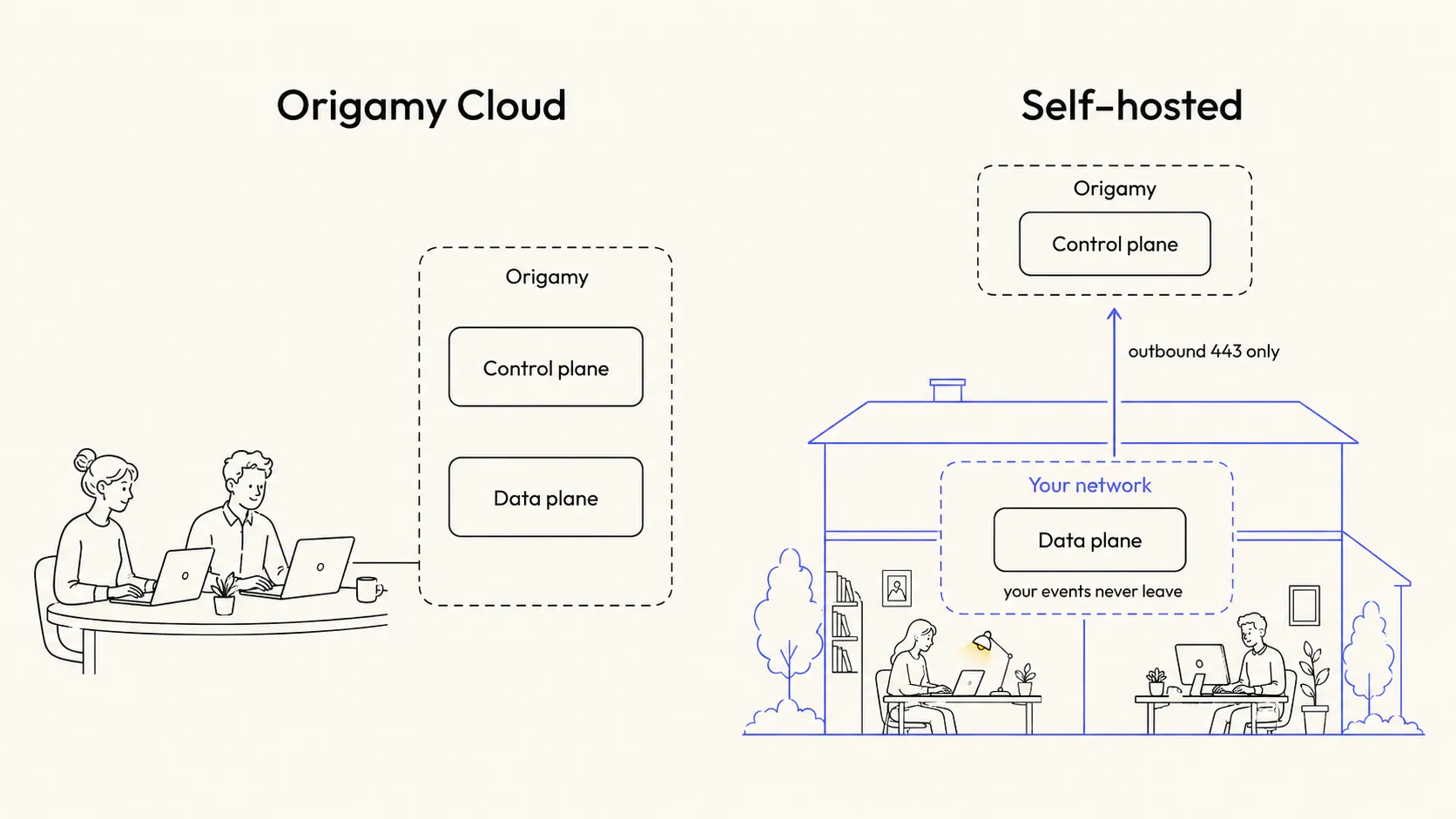
Section titled “Deployment topologies”Both topologies run the same data plane. The only difference is who operates it and where your data sits.
| Origamy Cloud | Self-hosted | |
|---|---|---|
| Control plane | Origamy-hosted | Origamy-hosted |
| Data plane | Origamy-hosted | Your VPC / cluster |
| Event data lives | Origamy Cloud, workspace-isolated | Your network — it never leaves |
| Network requirements | None | Outbound TCP 443 only |
| Install | Nothing to install | One CLI command (Docker or Kubernetes) |
Tenancy and isolation
Section titled “Tenancy and isolation”Every object in Origamy — sources, events, profiles, segments, journeys, API calls — is scoped to a workspace. Write keys identify a single source in a single workspace; admin API access is workspace-bound. Self-hosting adds a second, physical boundary: the datastores holding your events run in infrastructure you control, under your keys.
What it’s built on
Section titled “What it’s built on”Boring, proven infrastructure, chosen so a self-hosted data plane is something a platform team can actually operate:
| Component | Role |
|---|---|
| Go services | Every pipeline service is a small, single-purpose Go binary |
| NATS JetStream | Durable event bus between pipeline stages |
| ClickHouse | Columnar store for events and analytics |
| PostgreSQL | Operational store (configuration, form responses, delivery state) |
| Redis | Caching and short-lived pipeline state |
| Sandboxed JS runtime | Runs your transformations in isolation — no arbitrary host access |
No part of the pipeline requires a proprietary datastore, and the self-hosted bundle ships all of the above preconfigured — see Self-hosting for the operational details.